



What if the “18k gold” in a pair of earrings describes the finish, not the whole piece? That’s the distinction to keep in mind when shopping for 18k gold pvd coated earrings: the coating gives a gold-look surface, but the earrings aren’t necessarily solid 18-carat gold. The words “PVD” alone also don’t tell you what sits beneath the finish or how it will hold up to everyday wear.
Claims about lasting colour or water resistance can sound like guarantees, so it pays to check the details. This guide explains what PVD coating means, how it differs from conventional gold plating, and what the 18k description can and can’t tell you. You’ll learn what to look for in product information, how to assess durability claims and how to care for coated earrings. With a clearer picture of the base metal, finish and care needs, you can decide whether a pair suits your style and routine.
Key Takeaways
- Learn what “18k” describes on 18k gold pvd coated earrings, and which construction details it doesn’t confirm.
- Understand the broad steps used to apply a PVD finish, and why the process and materials matter.
- Assess durability claims by checking what’s disclosed about the coating, base metal and supporting evidence.
- Use a practical checklist to compare earrings, including posts, closures, care guidance and product imagery.
- Match a gold-toned finish to your style and care preferences without assuming every coating performs the same way.
What are 18k gold PVD coated earrings, exactly?
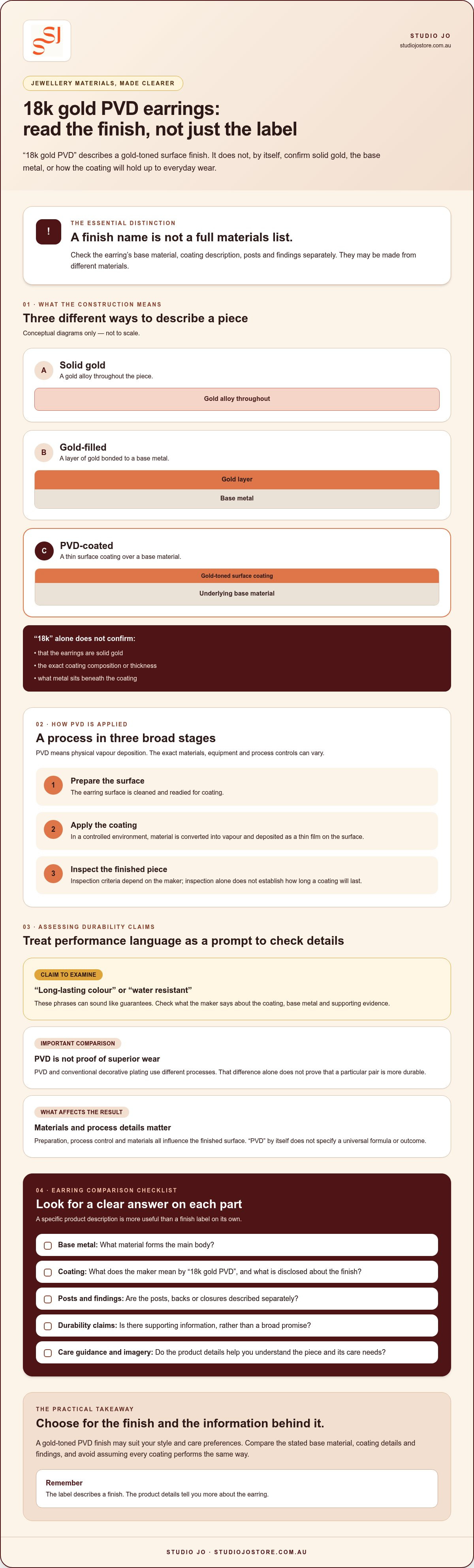
18k gold PVD coated earrings have a base material with a thin, gold-coloured surface coating applied using physical vapour deposition. The phrase describes a finish, not necessarily the material the earrings are made from. “18k” alone doesn’t confirm that the earrings are solid gold, or establish the coating’s precise composition or thickness.
Think of an earring as a few parts: the base metal forms the main body, the coating gives its surface a gold-toned appearance, and the posts and findings pass through the ear or secure the earring. These components may use different materials. A product description that names each one gives you a clearer picture than the finish label alone.
Does 18k gold PVD mean the earrings are solid gold?
No. Solid gold is made from a gold alloy throughout, while gold-filled jewellery has a layer of gold bonded to a base metal. A PVD-coated piece has a surface coating over a base material. These are different constructions, so don’t infer the amount of gold, or whether the coating contains gold, from “18k” alone. Check the product description for the base metal and the exact coating terminology.
If posts or closures aren’t described, don’t assume they’re made from the same material as the earring body. This detail can matter when comparing pieces or considering how they’ll suit your ears.
What does PVD stand for in jewellery?
PVD stands for physical vapour deposition, a process used to apply a thin coating to a surface. The name describes the general coating method, not one guaranteed formula or result. For an accessible overview of the process and its different methods, see Physical Vapor Deposition (PVD).
In broad terms, the earring’s surface is prepared, a coating is applied in a controlled environment, and the finished piece is inspected. The details depend on the materials and process used. PVD on its own doesn’t tell you exactly what the coating contains or how it will perform in daily wear.
That’s why a useful product listing should go beyond “18k gold PVD”. Look for a named base material, a clear description of the finish, and separate details for posts or findings where relevant. These specifics help you understand the piece you’re choosing instead of relying on a colour name to answer questions it can’t settle.
How does PVD gold coating get onto earrings?
PVD coating is applied through a manufacturing process, rather than simply describing a gold colour. The details vary with the equipment, materials and process controls used, so “PVD” alone can’t tell you exactly how a particular pair was made or how its finish will perform.
At a broad level, the process involves three stages:
- Preparation: The earring surface is cleaned and readied for coating.
- Coating application: In a controlled environment, material is converted into vapour and deposited as a thin film on the surface. Specific methods and set-ups vary.
- Inspection: The finished pieces are checked, though the inspection criteria depend on the maker and don’t, by themselves, establish how long a coating will last.
What happens during physical vapour deposition?
Physical vapour deposition forms a surface film from material in vapour form. The Wisconsin Centers for Nanoscale Technology’s overview of PVD explains the process in the context of producing thin films. In jewellery, PVD refers to the application method, not one universal gold formula. The coating material, equipment and layer structure need to be verified for a specific item.
That distinction matters when comparing PVD with conventional decorative plating. The processes differ, but that alone doesn’t prove one particular pair is more durable. Preparation, process control and materials all influence the finished surface. A comparative claim is more useful when the maker explains its basis, rather than relying on the word “PVD” as proof of performance.
Why does the base metal matter?
The coating sits on an underlying material, and that base remains part of the earring. Stainless steel is one example of a possible base metal, but don’t assume it’s used in every PVD-coated piece. Check the product description for the stated material, then look separately for details about the posts, backs or other findings, which may use different materials.
Tegan Rae jewellery includes pieces made using stainless steel and 18K PVD gold plating. This range-level information doesn’t confirm the construction of any particular earring, so check its individual product details. If you’re considering 18k gold pvd coated earrings, identify the base metal and coating description before weighing up claims about wear or care.
For a category-level example, you can explore Tegan Rae Jewellery. For a specific piece, use its product information to confirm the materials rather than inferring them from the finish name.
Are 18k gold PVD coated earrings more durable than ordinary gold plating?
PVD is often associated with durable finishes, but that doesn’t make every PVD-coated earring longer-lasting than every conventionally gold-plated one. The process name is not a lifetime-wear guarantee. The result depends on the particular coating, base material, manufacturing controls and how the earrings are worn and cared for.
Rather than relying on broad claims such as “ten times more durable”, look for a named test, its conditions and the specific product it applies to. Without that evidence, a comparison may not tell you how a finish will behave through your everyday routine.
| What to compare | PVD-coated jewellery | Conventionally gold-plated jewellery |
|---|---|---|
| Process | Gold-coloured coating applied using physical vapour deposition. | Gold coating applied by a plating process; exact methods can vary. |
| Materials | Check the stated coating and underlying metal. | Check the stated gold layer and underlying metal. |
| Wear and care | Performance and care needs depend on the particular piece. | Performance and care needs also depend on the particular piece. |
| Evidence | Look for product-specific test details behind durability claims. | Look for the same clarity about claims and test conditions. |
What affects how long a PVD finish lasts?
Coating quality, base material and manufacturing controls all matter, as do the wearer’s habits. Repeated rubbing against hair, clothing or other jewellery, impact, moisture and contact with chemicals may affect a surface finish. The amount of friction an earring experiences can also depend on its shape and how it sits. There’s no reliable lifespan to assign without product-specific evidence and defined wear conditions.
For a fair comparison, check whether a claim relates to the earrings themselves and whether the maker explains how the coating was tested. The phrase “PVD-coated” alone doesn’t answer either question.
What does water-resistant or tarnish-resistant actually promise?
Water resistance and resistance to wear are separate questions. A water-resistant description might refer to a particular product’s performance under specified conditions, but it doesn’t automatically establish how well the coating withstands friction, impact or repeated wear. “Tarnish-resistant” also needs context: look for product-specific details, not just a broad marketing phrase.
Even if a pair is described as water-resistant, follow the maker’s care advice. For 18k gold pvd coated earrings, check what the claim covers and whether the guidance recommends removing them before swimming, showering or applying personal-care products. Clear limits are more useful than a promise that sounds absolute.
How can you assess and care for PVD coated earrings?
A useful product description should help you understand both the visible finish and the earring beneath it. Before choosing 18k gold pvd coated earrings, use this checklist to see what’s clear, what’s missing and what you may want to confirm with the maker.
- Base metal: Check what the earring body is made from. A guide to stainless steel jewellery can help you understand the base material, which is separate from a PVD coating.
- Coating description: Look for a clear explanation of the surface finish. “18k gold” doesn’t, by itself, specify the base metal or all the details of the coating.
- Posts and backs: Check whether these are identified separately from the decorative part of the earring. They may not be made from the same material.
- Care instructions: Look for guidance specific to that piece, rather than assuming all PVD finishes need the same care.
- Product imagery: Clear images from more than one angle can help you inspect the visible finish and construction. Images can’t confirm materials, so pair them with written details.
What product details should you check before choosing?
Read broad claims such as “waterproof”, “non-tarnish” or “suitable for sensitive ears” as prompts to look for product-specific explanations. What conditions does a water-related claim cover? Are the posts included in a material or sensitivity statement? If the listing doesn’t say, don’t assume the claim applies to every component or wearer.
For broader context, a guide to waterproof jewellery can help you think about exposure and materials, while a guide to sweat-proof jewellery may offer useful everyday-wear considerations. These topics don’t replace the maker’s care instructions for a particular pair.
How should you care for coated earrings?
Start with the maker’s advice. Unless it recommends something different, gently wipe the earrings with a soft, dry cloth after wearing. Avoid abrasive cleaners and rough materials, which can scratch a surface finish. Store each pair separately to reduce rubbing against other jewellery, and take care not to knock or scrape the coating against hard surfaces.
Water exposure and daily wear aren’t the same question, so don’t treat “waterproof” wording as a reason to ignore care guidance. If you’re comparing gold-toned styles, explore Tegan Rae Jewellery and check the details listed for each piece before deciding whether its materials and care needs suit your routine.
Where 18k gold PVD earrings fit in everyday jewellery
A gold-toned finish can bring warmth and polish to an everyday look, from a simple pair worn on its own to a considered mix of metals. But PVD-coated earrings are still jewellery with a surface coating, not solid gold throughout. The right choice depends on what matters most to you: the look, the materials beneath the finish, the care involved and how the piece fits your budget.
Who might prefer coated gold-toned earrings?
If you’re drawn to the appearance of gold and want to compare clearly disclosed materials, PVD-coated styles may be worth considering. Design matters too. You might prefer a subtle gold accent for daily outfits or a more expressive look for occasions. Think about whether you’re comfortable following the maker’s care guidance to help look after the finish.
Read the description before deciding. “18k” in a coating label doesn’t mean the whole earring is 18-carat gold, and a gold-toned surface may appeal for its appearance without being a substitute for solid gold. If solid-gold composition is your priority, compare pieces made from solid gold instead.
When should you consider another material or finish?
If you prioritise solid-gold content or have known metal sensitivities, take time to compare materials. Check the earring body, posts and backs separately where details are available. A coating or general sensitivity claim may not explain every component. If you have individual concerns about how a material may affect you, consider seeking advice from a qualified health professional.
For broader context on gold finishes and wearing jewellery day to day, consult a gold jewellery guide, and use product-specific care advice to inform your choice. This helps keep the distinction clear between a gold appearance, the underlying metal and the way a piece may need to be cared for.
Tegan Rae Jewellery is an Australian label whose range includes stainless steel and 18K PVD gold-plated pieces. That category-level information doesn’t confirm the construction, care needs or availability of any particular earring, so check the individual product details. If you’re weighing up 18k gold pvd coated earrings, let the disclosed materials and your care preferences guide your decision, alongside the look you love.
Explore the Tegan Rae Jewellery range and review each piece’s details to see whether its materials and finish align with your everyday style.
Choose your finish with confidence
The key to choosing 18k gold pvd coated earrings is knowing what the label tells you and what it leaves out. PVD describes a coating process, not solid-gold construction. The base metal, posts and finish all matter, so check the product details rather than relying on the gold-colour description alone.
A gold-toned coating may suit your style, but it isn’t a promise of lifetime wear or water resistance. Look for clear, product-specific claims and follow the maker’s care guidance to help look after the finish.
Studio Jo features Tegan Rae Jewellery, an Australian label with pieces made using materials such as stainless steel and 18K PVD gold plating. Explore the range and review the details of each piece before choosing one for your everyday rotation.
Browse Tegan Rae Jewellery and check the individual product details to find a finish that suits your style and care preferences.
Frequently Asked Questions
Is 18k gold PVD coated jewellery real gold?
Not necessarily. The phrase 18k gold pvd coated earrings describes a gold-coloured PVD finish, but it doesn’t confirm the earrings are made from solid 18-carat gold. Check the product specification for separate details about the base material and coating. If the description doesn’t clarify what “18k” means or what the coating contains, ask the retailer before you buy.
Can you shower with 18k gold PVD coated earrings?
It depends on the specific earrings and their maker’s care advice. “Water-resistant” doesn’t automatically mean suitable for frequent showers, swimming or contact with toiletries. Check whether the product information explains what kind of water exposure its claim covers. If it’s unclear, the safer choice is to remove the earrings before showering. If they get wet, dry them gently and follow the maker’s instructions.
How long do 18k gold PVD coated earrings last?
There’s no reliable single lifespan that applies to every pair. Wear can depend on the base material, coating process and quality control, as well as friction, exposure and care. Treat a precise durability figure as a product-specific claim, and look for evidence explaining how it was tested and under what conditions. PVD doesn’t mean a finish can never fade or wear, so follow the maker’s care guidance.
Are PVD coated earrings better than gold-plated earrings?
Neither label alone proves that one pair will perform better in every situation. PVD describes a coating application process, while “gold-plated” can cover products with different materials and specifications. Compare the disclosed base metal, coating details, test evidence and care advice for the earrings you’re considering. Be cautious of numerical durability comparisons unless the seller explains the test method and conditions behind them.
Can 18k gold PVD coated earrings cause skin irritation?
Yes, they can cause irritation for some people, depending on the materials used and individual sensitivities. The coating name doesn’t confirm what the posts, backs or other skin-contacting parts are made from. Check the material details for each component, rather than relying on a general claim about the finish. If you have a known metal sensitivity, seek appropriate professional advice before wearing unfamiliar jewellery.
What does 18k mean on PVD coated earrings?
It usually describes the stated gold tone or finish, but it doesn’t, by itself, confirm the earrings are solid 18-carat gold. Product terminology can vary, so check how the seller describes both the surface coating and the underlying material. If the listing doesn’t make those details clear, ask the retailer to clarify them before deciding whether the earrings meet your expectations.
How should you clean 18k gold PVD coated earrings?
Start with the care instructions for your specific pair. Unless the maker advises otherwise, gently wipe the earrings with a soft, dry cloth to remove everyday residue. Avoid abrasive materials and harsh cleaners, which may affect the surface finish. If the earrings become damp, dry them gently. Store them separately from other jewellery to reduce rubbing and the chance of scratches.